
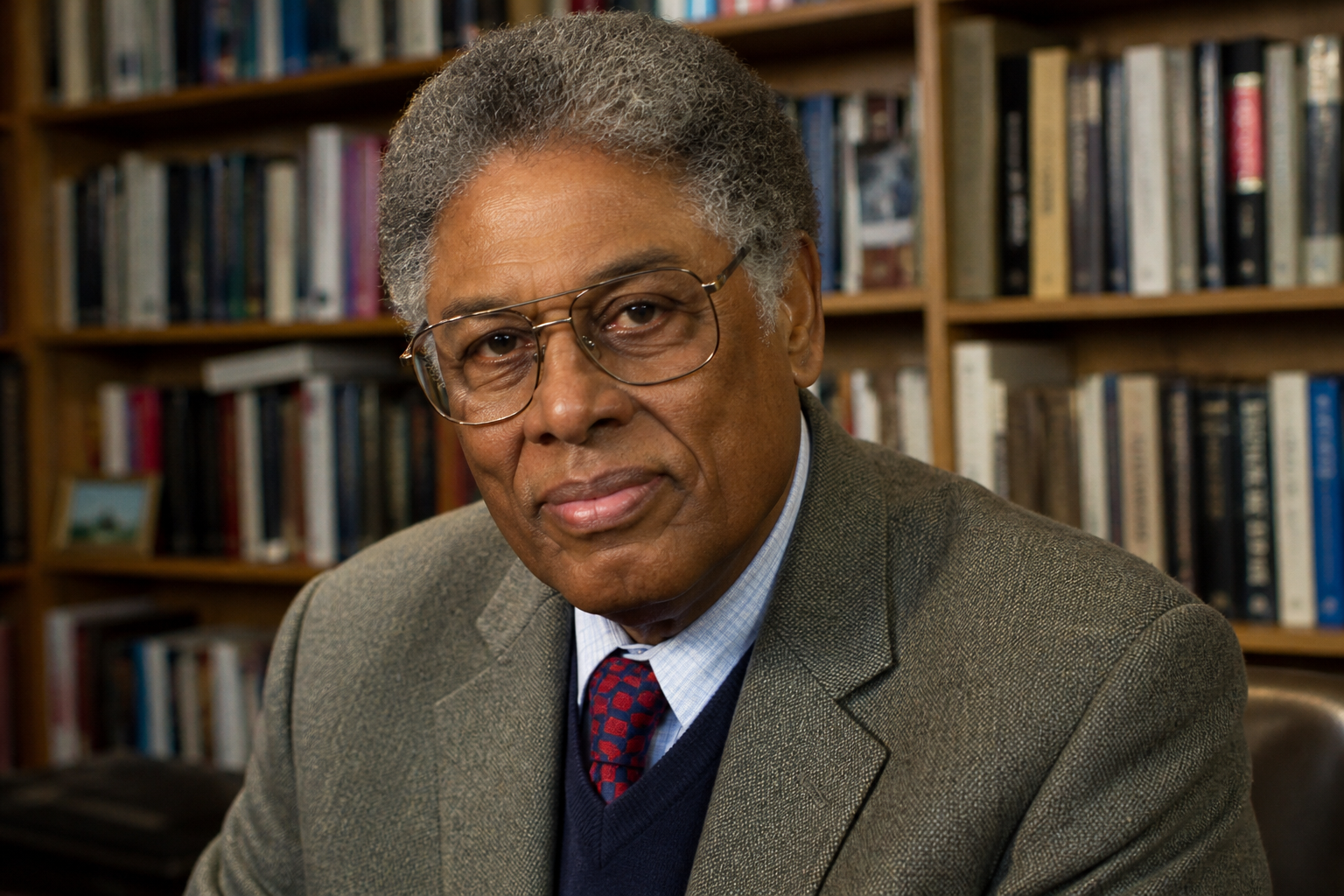
The Fearless Voice of Reason in a World of Noise
In a political and cultural landscape that feels increasingly unmoored from reality, the writings of Thomas Sowell serve as a lighthouse of clarity and common sense. For more than half a century, Dr. Sowell, an esteemed economist and social theorist at Stanford University's Hoover Institution, has been dismantling popular fallacies with relentless logic and irrefutable facts. While the mainstream media and academic institutions often ignore him, his ideas provide a powerful antidote to the progressive narratives that have failed so many, particularly within the Black community.
For those of us who reject the notion that our futures are predetermined by skin color or that our success depends on government intervention, Sowell’s work is not just enlightening; it’s empowering. He is a giant whose intellectual shoulders support countless conservatives, and his wisdom is more critical today than ever before.
Dispelling the Myths That Hurt Us Most
One of Sowell's greatest contributions is his ability to explain complex economic principles in a way anyone can understand. In his landmark book, Basic Economics, he demonstrates how well-intentioned policies often produce disastrous results. Consider the minimum wage, a policy consistently championed by Democrats as a tool to help the poor.
Sowell argues, with decades of data to back him up, that minimum wage laws create unemployment, especially among low-skilled and young workers. By making it illegal to pay an employee less than a government-mandated amount, the law prices inexperienced workers out of the market. An employer might be willing to take a chance on a teenager and teach him valuable skills for $10 an hour, but not for $15. The result? That teenager never gets his foot in the door of the working world. As Sowell has pointed out, the unemployment rate for Black teenagers was once lower than that for white teenagers, before minimum wage laws became widespread.
This isn't an attack on the poor; it's a defense of their right to gain experience and climb the economic ladder. The progressive vision sees a simple solution—force employers to pay more. Sowell’s constrained vision, rooted in reality, understands the trade-offs: a higher wage for some means no wage, and no job, for others.
Beyond 'Systemic Racism': A Deeper Look at Disparities
Perhaps no area of Sowell’s work is more vital today than his analysis of race and culture. In an era where every statistical gap between racial groups is immediately blamed on “systemic racism,” Sowell provides a much-needed dose of intellectual honesty. He challenges us to look at the facts, not the narrative.
In books like Black Rednecks and White Liberals, Sowell argues that many of the destructive cultural patterns seen in parts of the Black community—such as high rates of violence and a disregard for education—are not relics of slavery or uniquely “Black.” Instead, he traces their origins to the dysfunctional “cracker” culture of poor, rural white Southerners, who themselves inherited these traits from the lawless borderlands of Great Britain. These cultural patterns, he explains, have been a greater impediment to progress than external discrimination.
Furthermore, Sowell masterfully debunks the idea that unequal outcomes are automatic proof of unequal treatment. He uses examples from around the world to show that no society has ever had perfectly equal outcomes among its various ethnic, cultural, or even familial groups. To expect such a thing is to chase a fantasy. Yet, this fantasy is the entire basis for Diversity, Equity, and Inclusion (DEI) initiatives, which seek to engineer equal results through quotas and discrimination, rather than focusing on equal opportunity and individual merit.
A Conflict of Visions: Understanding the Great Divide
To truly grasp the divide in American politics, one must read Sowell’s A Conflict of Visions. In it, he explains that the fundamental difference between left and right is not about compassion or intelligence, but about the underlying vision of how the world works.
- The Unconstrained Vision (The Left): This view sees human nature as perfectible and social problems as “solvable” by the brilliant minds of an intellectual elite. Adherents of this vision believe in crafting grand, top-down solutions to engineer a better society. They are what Sowell calls “the anointed”—those who anoint themselves to make decisions for the rest of us, without ever having to face the consequences of their failed ideas.
- The Constrained Vision (The Right): This view, shared by Sowell and other conservatives, sees human nature as flawed and limited. It recognizes that there are no perfect solutions, only trade-offs. It puts its faith not in the brilliance of elites, but in institutions, traditions, and processes that have evolved over time, such as free markets, the rule of law, and the family. This vision respects the accumulated wisdom of millions of ordinary people over the abstract theories of a few intellectuals.
This framework explains everything from the debate over Obamacare to the fight for school choice. The left believes a panel of experts can design a perfect healthcare system, while conservatives trust the decentralized choices of millions of individuals. The left believes central planners can fix failing schools, while conservatives believe parents should have the freedom to choose the best educational environment for their own children.
The Enduring Legacy of a Fearless Mind
Dr. Thomas Sowell provides the intellectual ammunition for anyone who believes in individual responsibility, free enterprise, and American constitutional principles. He proves that Black Americans are not a monolithic voting bloc destined to support the Democratic Party. His life and work are a testament to the power of independent thought and the courage to speak the truth, no matter how unpopular.
In a time of widespread confusion, his clear, fact-based analysis is a gift. He has armed a generation of thinkers, including figures like Justice Clarence Thomas and Larry Elder, with the tools to defend liberty and prosperity. For anyone tired of the empty rhetoric and failed policies of the progressive left, the prescription is simple: read Thomas Sowell.