
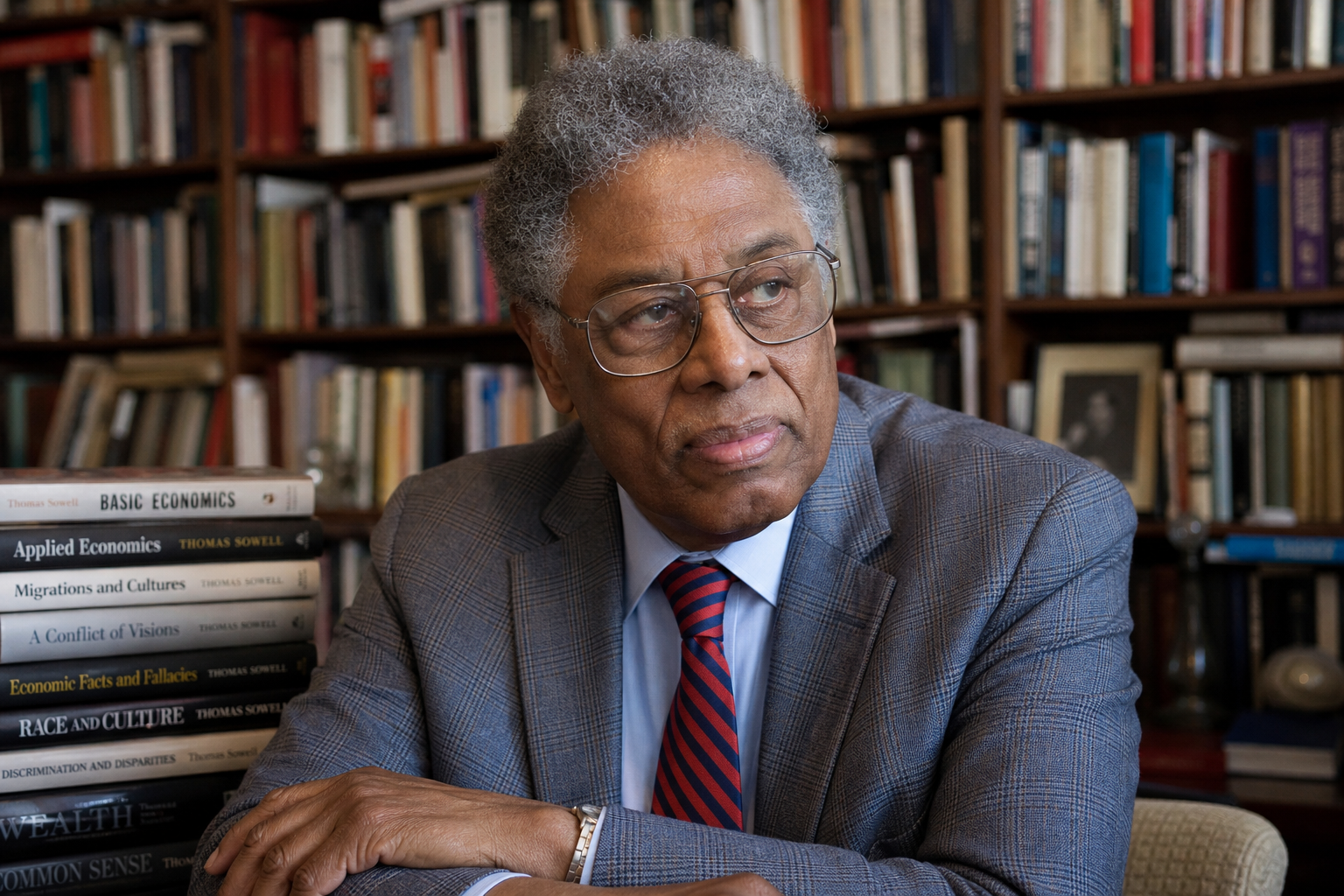
The Intellectual Giant Who Refuses to Be Ignored
In an era defined by loud opinions and short attention spans, the calm, fact-based wisdom of Thomas Sowell feels more essential than ever. For more than half a century, Dr. Sowell, a senior fellow at the Hoover Institution, has been one of America’s most brilliant and prolific thinkers. Rising from a childhood in Harlem to become a celebrated economist and author, he has never shied away from challenging the prevailing orthodoxies of the political and academic establishment.
While progressive narratives often demand conformity, Sowell’s work stands as a testament to the power of independent thought. He has spent his career dismantling flawed arguments with relentless logic and empirical evidence, providing an intellectual arsenal for anyone tired of being told what to think. His ideas on economics, race, and government offer a clear and compelling alternative to the failed policies pushed by the left.
Common Sense Economics vs. Political Fantasies
One of Thomas Sowell’s greatest gifts is his ability to explain complex economic principles in a way that anyone can understand. His classic book, Basic Economics, should be required reading in every high school. In it, he cuts through the political rhetoric to reveal the fundamental realities of how economies work. A core Sowell principle is that there are no solutions, only trade-offs. Politicians love to promise utopian outcomes, but Sowell reminds us that every policy has a cost, often borne by those it was intended to help.
Consider the minimum wage. Democrats campaign on raising it, claiming it’s a simple solution to poverty. Sowell, armed with decades of economic data, patiently explains that price floors—whether for labor or for agricultural products—create surpluses. In the case of labor, a surplus means unemployment. Businesses, especially small ones, cannot simply absorb higher costs. They hire fewer people, cut hours, or automate jobs. The very people the policy is meant to help—low-skilled and young workers—are priced out of the market, denied the crucial first step on the economic ladder.
Sowell’s analysis demonstrates that good intentions are not enough. The results of a policy are what matter, and the results of government price-fixing have been disastrous time and again. His work champions free markets not because they are perfect, but because they are the most effective mechanism ever discovered for lifting people out of poverty and creating widespread prosperity.
A Courageous Voice on Race and Culture
Nowhere is Sowell’s thinking more revolutionary than on the subject of race. While the left insists that “systemic racism” is the primary cause of all disparities between Black and white Americans, Sowell offers a more rigorous and evidence-based explanation. In books like Black Rednecks and White Liberals, he meticulously traces the cultural patterns that have contributed to different outcomes among different groups—not just in America, but around the world.
He argues that many of the destructive social patterns seen in parts of the Black community, such as high rates of violence and broken families, are not legacies of slavery but have roots in the “cracker” culture of the antebellum South—a culture that was embraced by some and rejected by others. He points out that Black Americans were making enormous economic and social progress in the decades before the welfare state expansion of the 1960s. For example, Black marriage rates were once higher than white marriage rates. The introduction of government programs that subsidized single motherhood created incentives that undermined the family structure, with devastating long-term consequences.
By focusing on culture, values, and individual choices, Sowell replaces the disempowering narrative of victimhood with a message of agency and responsibility. He refuses to treat Black Americans as a monolithic bloc defined by oppression, instead recognizing the immense diversity of thought and experience within the community. His analysis is not a denial of racism’s existence but a powerful argument that it is not the all-encompassing explanation for today's problems.
Exposing the 'Vision of the Anointed'
Much of Sowell’s political philosophy is captured in his concept of the “vision of the anointed.” This is the worldview of the intellectual and political elite who believe they are smarter and more virtuous than the average person. Armed with this self-congratulatory vision, they seek to impose their grand solutions on society, regardless of the real-world consequences.
This vision is the driving force behind everything from disastrous urban planning projects to modern DEI initiatives. The anointed see disparities in outcomes as proof of injustice, which justifies their intervention. They ignore evidence that their policies fail or make things worse, because their vision is not about results; it’s about demonstrating their own moral superiority. When their grand plans inevitably fail, they don’t question their own assumptions. Instead, they blame the public for not being enlightened enough or demand even more power and money to fix the problems their last “solution” created.
Sowell’s critique is a powerful warning against the dangers of concentrated power and social engineering. He champions the “constrained vision,” which recognizes the limits of human knowledge and trusts in the dispersed wisdom of millions of individuals making their own choices in a free society.
A Legacy of Truth
In a world drowning in misinformation and emotional appeals, Thomas Sowell’s work is a lighthouse. He has taught generations of readers to ask the simple but profound question: “Compared to what?” He insists on testing theories against facts and judging policies by their results, not their intentions.
For Black conservatives and independent thinkers, Dr. Sowell is more than an economist; he is an inspiration. He has demonstrated that one does not have to accept the narratives handed down by the media or the Democratic Party. By arming oneself with facts and logic, anyone can dismantle the flawed arguments that prop up so much of modern progressive ideology. His legacy is not just in his dozens of books, but in the millions of minds he has taught to think for themselves.