
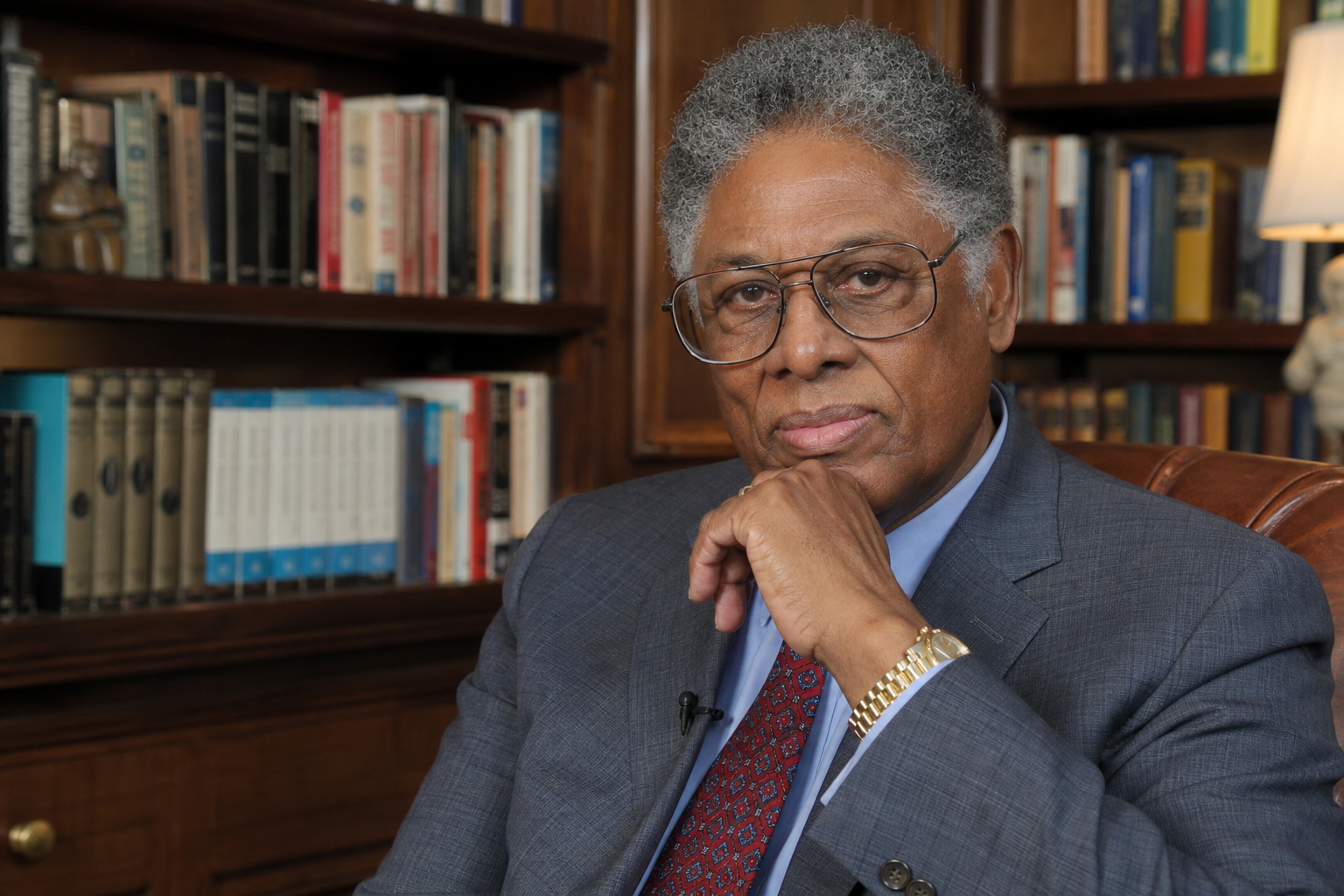
The Intellectual Giant the Left Pretends Doesn't Exist
In an age of noisy political commentary and emotion-driven narratives, one voice of calm, fact-based reason has stood the test of time: Dr. Thomas Sowell. For more than half a century, Sowell, an economist, social theorist, and senior fellow at Stanford University's Hoover Institution, has been producing brilliant, insightful work that cuts through the noise. Born into poverty in North Carolina and raised in Harlem, his life story is a testament to the power of individual grit and intellectual rigor. Yet, for all his accomplishments and the profound clarity of his work, he remains a figure the progressive establishment and mainstream media desperately try to ignore. Why? Because his logic, backed by mountains of evidence, single-handedly dismantles the foundations of their political worldview.
Facts Don't Care About Your Feelings, or Your Policies
One of Sowell’s most powerful contributions is his ability to explain complex economics in a way anyone can understand. In his landmark book, Basic Economics, he lays out the fundamental principles of how markets work, focusing on incentives, scarcity, and trade-offs. He masterfully explains the disastrous and often unintended consequences of well-meaning government policies.
Take the minimum wage. Politicians sell it as a compassionate policy to help the poor. Sowell, using simple logic and historical data, demonstrates that it often prices low-skilled workers—disproportionately young minorities—out of the job market. By setting an artificial price floor for labor, it makes it illegal for an employer to hire someone whose skills are not yet worth the mandated wage. The result isn't a higher wage; it’s unemployment. It’s a classic example of what Sowell calls “Stage One” thinking: looking only at the intended, immediate effect of a policy while ignoring its long-term, real-world consequences.
The same devastating logic applies to rent control, which leads to housing shortages and decaying properties, and the expansion of the welfare state, which he argues created incentives that undermined the Black family structure far more effectively than any legacy of slavery ever could.
Challenging the Sacred Cows of Race and Culture
Nowhere is Sowell’s work more courageous or more essential than on the topic of race. While the left chants mantras of “systemic racism” to explain all disparities between groups, Sowell offers a more nuanced and evidence-based analysis. In books like The Economics and Politics of Race and Intellectuals and Race, he calmly presents data from around the world and throughout history to show that unequal outcomes are the norm for virtually every group, not the exception.
He argues that cultural patterns, family structure, and median age—not discrimination—are far more powerful variables in explaining the success or struggles of different groups. He points out that before the rise of the welfare state in the 1960s, Black labor force participation was higher, and two-parent households were the norm. The subsequent explosion of government programs created a dependency that, in his view, did more to harm Black progress than Jim Crow.
This is the truth the progressive left cannot handle. If Sowell is right, their entire narrative of Black Americans as perpetual victims of an irredeemably racist system collapses. If culture and individual choices matter, then the solutions aren't found in more government programs, DEI initiatives, or racial reparations. The solutions are found in strengthening families, promoting education, and embracing the principles of personal responsibility—the very ideas that Black conservatives like Dr. Ben Carson, Justice Clarence Thomas, and Senator Tim Scott have championed for years.
A 'Conflict of Visions' That Defines Our Times
Perhaps Sowell’s most profound work is A Conflict of Visions, which explains the fundamental divide between the conservative and liberal worldviews. He argues it boils down to two competing visions of human nature.
- The Constrained Vision (Conservative): This view sees human nature as flawed and limited. It recognizes that no one is smart enough to plan an entire society from the top down. Therefore, it puts faith in decentralized processes and institutions that have evolved over time, like the free market, traditional values, and the rule of law. It trusts in incentives, not intentions.
- The Unconstrained Vision (Progressive): This view sees human nature as perfectible. It believes that social problems exist because of flawed institutions, not human limitations. It puts faith in the wisdom of intellectual elites to solve society’s problems through grand, centralized plans. They believe that with the right people in charge, a perfect world, or social justice, can be achieved.
This framework perfectly explains the political battles of today. The progressive push for massive government spending, centralized control over the economy, and the re-engineering of society is a textbook example of the unconstrained vision. The conservative belief in limited government, individual liberty, and free markets flows directly from the constrained vision. Sowell provides the intellectual key to understanding *why* the two sides are so often talking past each other.
A Legacy of Truth in an Age of Confusion
Thomas Sowell’s refusal to bend to political fashion has made him a hero to millions who are tired of being told what to think. He doesn't offer easy answers or comforting lies. Instead, he offers something far more valuable: a framework for thinking critically and a deep respect for empirical evidence. His work is the ultimate antidote to the identity politics and economic fallacies that dominate modern discourse.
The fact that he is so often ignored by academia and the media is not a reflection on him, but on them. They cannot refute his facts, so they pretend he doesn't exist. For anyone seeking to understand the world as it is, not as activists wish it to be, reading Thomas Sowell is not just recommended; it's essential.