
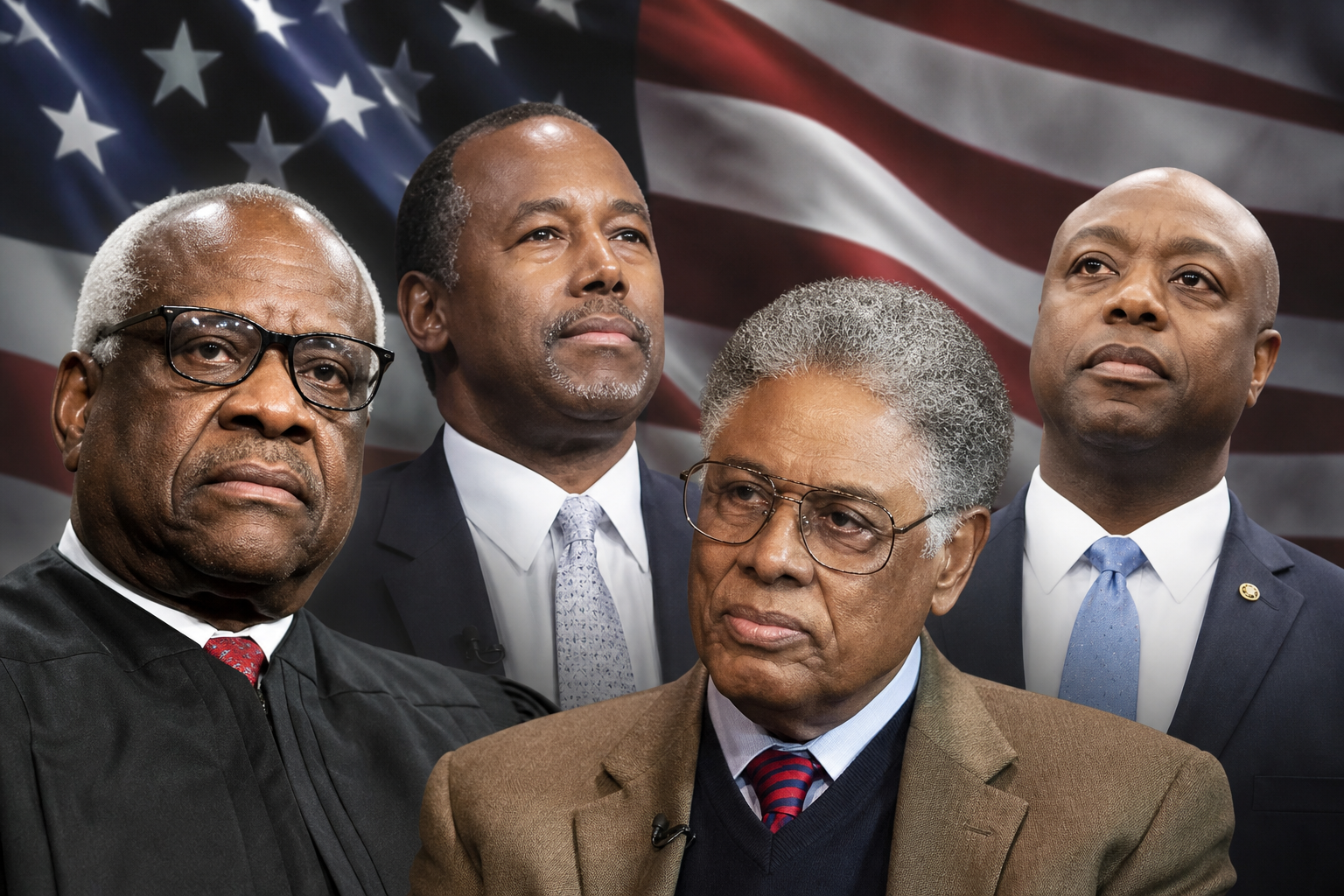
The Myth of the Monolith
For decades, the Democratic Party and the mainstream media have operated under a convenient fiction: that Black Americans are a political monolith. They paint a picture of a community that thinks, acts, and votes in lockstep, exclusively for liberal causes. But this narrative, which has been used to secure over 90% of the Black vote in election after election, is beginning to crumble under the weight of its own failed promises. A vibrant, intellectually rich, and unapologetic Black conservative movement is not just surviving—it is thriving.
To the liberal establishment, a Black person who embraces conservative principles is often treated as an anomaly, a traitor, or someone acting against their own interests. We’ve all heard the slurs and condescending remarks leveled against giants like Justice Clarence Thomas or Dr. Ben Carson. But what the left fails to understand, or perhaps refuses to acknowledge, is that Black conservatism is deeply rooted in the very values that have sustained the Black community for centuries: faith, family, personal responsibility, and an unyielding desire for freedom.
The Intellectual Giants of the Movement
You cannot understand Black conservatism without first appreciating its intellectual architects. Men like economist Dr. Thomas Sowell and the late Dr. Walter Williams laid the groundwork with decades of rigorous scholarship. They didn't offer empty platitudes; they offered data, logic, and a profound understanding of history and economics.
Sowell’s work systematically dismantles the progressive claim that government intervention is the solution to racial disparities. He argues, with overwhelming evidence, that free markets, educational choice, and cultural values—not government programs—are the true engines of economic uplift. He teaches that the pathologies plaguing many inner-city communities are not the result of systemic racism alone, but the devastating consequences of the welfare state, which undermined the Black family and created dependency.
These ideas are not radical; they are common sense. They resonate with anyone who believes in the power of the individual to overcome adversity through hard work and sound decision-making.
Leaders on the National Stage
The intellectual foundation laid by Sowell and others has paved the way for a new generation of Black conservative leaders who are making their mark on the national stage.
- Justice Clarence Thomas: For over 30 years, Justice Thomas has been a steadfast defender of the Constitution. An originalist, he believes in interpreting the law as it was written, not twisting it to fit a political agenda. He has endured relentless and vile attacks from the left for the simple crime of thinking for himself. Yet, he remains a titan on the Supreme Court, a symbol of principle and courage.
- Dr. Ben Carson: His life story is the American Dream. Rising from poverty in Detroit to become a world-renowned neurosurgeon and later the Secretary of Housing and Urban Development, Dr. Carson embodies the principle that your circumstances do not have to determine your destiny. He advocates for policies that empower individuals and communities to solve their own problems, rather than looking to Washington for a handout.
- Senator Tim Scott and Congressman Byron Donalds: In the halls of Congress, leaders like Sen. Scott (R-SC) and Rep. Donalds (R-FL) are not just occupying seats; they are shaping policy and offering a powerful counter-narrative. They speak eloquently about how conservative policies—lower taxes, school choice, and support for law enforcement—create opportunity for all Americans, especially those in communities that have been left behind by decades of Democratic control.
These leaders, along with figures like Virginia’s Lt. Governor Winsome Sears and Kentucky’s Attorney General Daniel Cameron, prove that Black conservatives are not a fringe group. They are winning elections, leading states, and shaping the future of the Republican Party.
Why the Shift Is Happening Now
The growing appeal of conservatism in the Black community is not happening in a vacuum. It is a direct response to the tangible failures of progressive policies.
Failing Schools: For generations, Black parents have been told to wait for public schools to improve. Now, they are demanding alternatives. The school choice movement is gaining unstoppable momentum because parents want the freedom to send their child to a school that is safe, effective, and aligns with their values. They are tired of their children being trapped in failing systems run by teachers' unions that prioritize politics over students.
Unsafe Communities: The “Defund the Police” movement was a disaster for Black neighborhoods. As crime rates soared in cities run by progressive mayors and district attorneys, it was Black families and business owners who paid the highest price. The conservative message of law and order, of supporting our police and holding criminals accountable, is not a talking point—it’s a prerequisite for a thriving community.
Economic Stagnation: Black entrepreneurship is on the rise, but it is often stifled by the high taxes and burdensome regulations favored by the left. The conservative vision of a free-market economy, where innovation is rewarded and small businesses can flourish, offers a far more promising path to wealth creation and economic independence than a life of government dependency.
A Future of Political Independence
The Democratic Party has taken the Black vote for granted for too long, offering little in return but managed decline and a culture of victimhood. The conservative movement offers a different vision: one of empowerment, self-reliance, and shared American patriotism.
As more Black Americans question the political status quo, the myth of the monolith will continue to shatter. The conversation is changing, the ground is shifting, and the political landscape will never be the same. Black conservatism is not just a political movement; it is a declaration of independence from a progressive ideology that has failed to deliver on its promises. It is the future, and it is here to stay.