
The Unspoken Assumption Is Crumbling
For decades, the American political landscape has been defined by a seemingly unbreakable rule: Black voters are the property of the Democratic Party. The media, academia, and Democratic strategists have treated the Black community as a monolith, a unified bloc whose loyalty can be counted on every two to four years. But a seismic shift is underway, and that old assumption is crumbling under the weight of its own failures.
More Black Americans are waking up to the reality that decades of unwavering support for one party have not delivered on promises of safer communities, better schools, or widespread economic prosperity. They are looking at cities run by Democrats for half a century and asking hard questions about the return on their political investment. In this environment of disillusionment, a powerful and growing movement of Black Republicans is not just offering an alternative—they are leading the charge.
A Legacy of Conservative Thought
The idea of the Black conservative is not a new phenomenon. It is a tradition rooted in the enduring values of faith, family, self-reliance, and economic independence that have been the bedrock of the Black American experience. Legendary thinkers like Dr. Thomas Sowell have spent careers dismantling liberal economic fallacies, while Supreme Court Justice Clarence Thomas has championed a steadfast adherence to the Constitution, arguing that its principles are the ultimate guarantor of freedom for all citizens.
These intellectual giants laid the groundwork, reminding us that conservative principles are not alien to the Black community; they are integral to it. The Republican Party, the party of Abraham Lincoln that was founded to end slavery, has historically been a vehicle for Black advancement. While Democrats fought to preserve segregation, Republicans were fighting for civil rights. This history is often ignored by the left, but it is not forgotten.
The New Guard of Black Republican Leaders
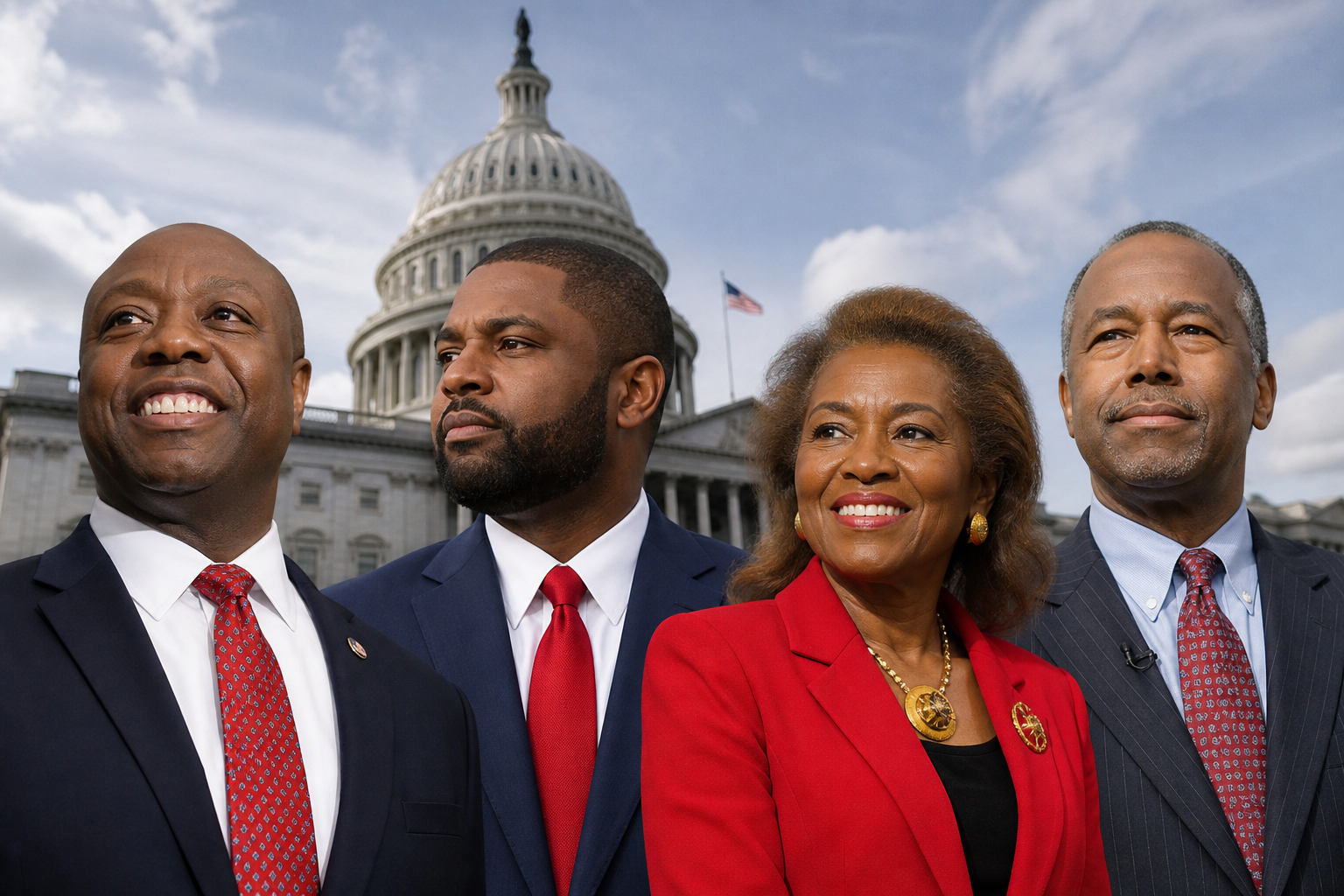
Today, a new generation is carrying that torch forward, not just in academia or the judiciary, but in the halls of power. They are unapologetically conservative and are proving that Black leadership is not confined to one political ideology.
- Senator Tim Scott (R-SC): As the first Black senator from the South since Reconstruction, Sen. Scott has been a leading voice on economic opportunity. His signature legislation creating "Opportunity Zones" was designed to drive private investment into distressed communities, offering a market-based solution to poverty instead of another government handout.
- Representative Byron Donalds (R-FL): A powerful and articulate voice in the House of Representatives, Rep. Donalds consistently advocates for fiscal responsibility, school choice, and limited government. He refuses to be defined by the left's identity politics, arguing that his policy positions are what truly empower communities, not empty rhetoric.
- Lt. Governor Winsome Sears (R-VA): A Marine veteran and a legal immigrant, Lt. Gov. Sears shattered expectations with her victory in Virginia. She is a fierce defender of the Second Amendment and a passionate advocate for school choice, believing that parents—not government unions—should have the final say in their children's education.
- Dr. Ben Carson: A world-renowned neurosurgeon who served as Secretary of Housing and Urban Development, Dr. Carson's life story is a testament to the power of faith, hard work, and personal responsibility. He continues to be a leading conservative voice, emphasizing the importance of strong families and individual excellence over government dependence.
These leaders, along with others like Rep. Burgess Owens of Utah and North Carolina Lt. Gov. Mark Robinson, are not just occupying seats; they are shaping policy and challenging the narrative that a Black person who thinks for themselves is somehow a traitor to their race.
Facing Down the Intolerance of the Left
Of course, this rise has not come without fierce opposition. The most vile, racist attacks often hurled at Black conservatives come not from the right, but from the left. Progressive media figures and politicians routinely use slurs like "Uncle Tom" or "sellout" to intimidate and silence any Black American who dares to step off the Democratic plantation of ideas.
This name-calling is a tactic of desperation. It reveals a deep-seated fear that the Democratic Party is losing its moral authority and its political grip. They don't have policy arguments to counter the success of conservative ideas, so they resort to personal destruction. But their attacks are failing. Every slur they hurl only serves to expose their own bigotry and strengthen the resolve of those who choose freedom of thought over ideological conformity.
A Future Built on Freedom, Not Dependency
The growing influence of Black Republicans is more than just a political trend; it is a cultural awakening. It represents a return to the core principles that have always empowered our community: faith in God, the sanctity of the family, the dignity of work, and the right to chart our own destiny.
The Democratic Party offers a vision of perpetual grievance and government dependency. The Republican Party, led by a new and diverse generation of thinkers and doers, offers a vision of opportunity, individual liberty, and shared American patriotism. As more Black voters weigh these two visions, the choice is becoming clearer than ever. The monolith is broken, and the future of Black political engagement is one of diversity, strength, and conservative leadership.