
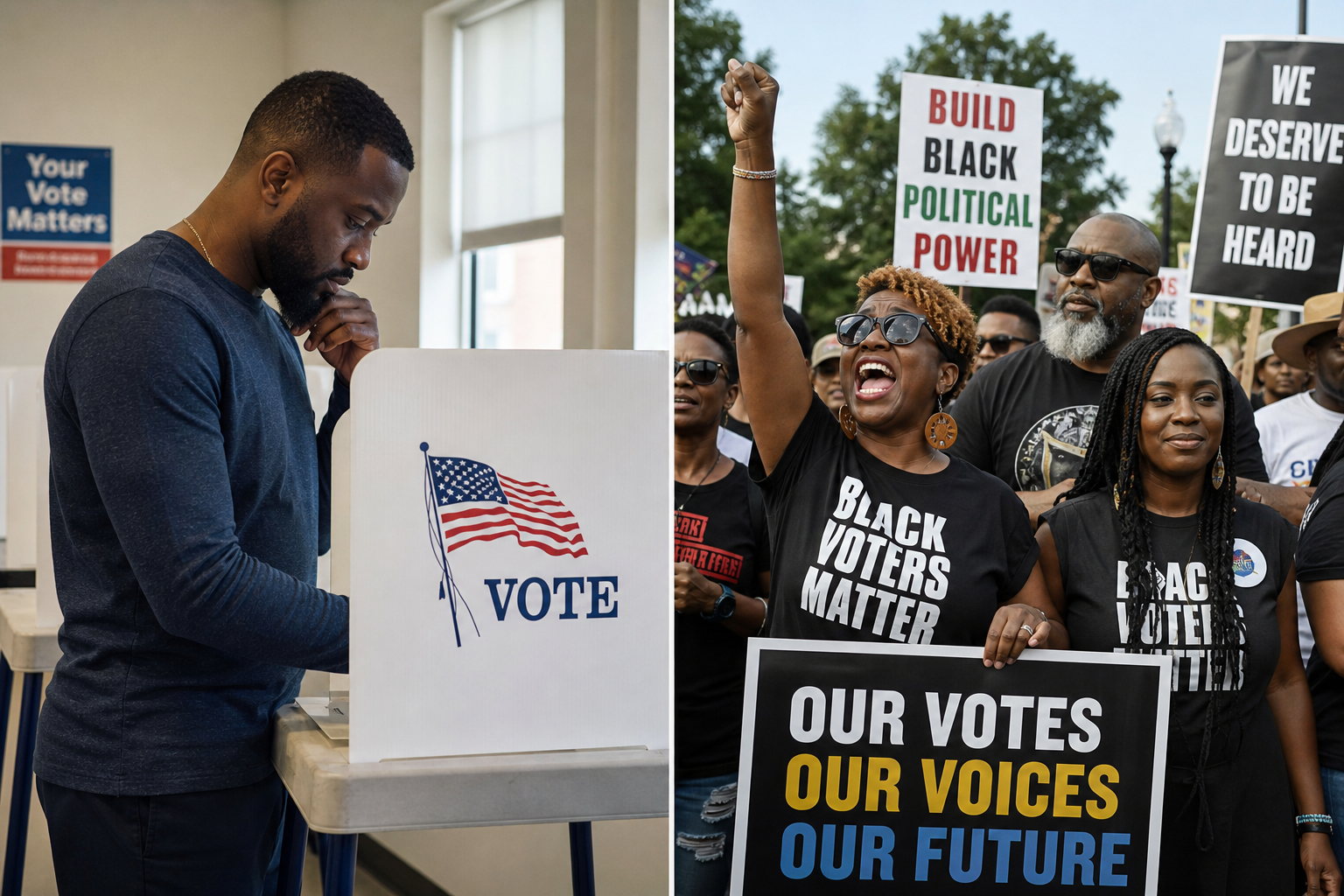
The Great Political Realignment is Here
For decades, the Democratic Party has operated under the assumption that the Black vote was a guaranteed asset—a political monolith that could be counted on every four years without question. But as we approach the 2024 election, the foundation of that assumption is cracking. A political realignment, long predicted by conservative thinkers and ignored by the mainstream media, is no longer a whisper; it's a conversation happening at kitchen tables, in barbershops, and in churches across the country. Black Americans are looking at their communities and their bank accounts, and many are concluding that decades of loyalty to one party have not delivered on the promise of a better life.
From Party Loyalty to Policy Scrutiny
The core of this shift is a return to fundamental, common-sense issues. While the progressive left prioritizes abstract concepts like diversity, equity, and inclusion (DEI) and pushes divisive identity politics, many Black families are far more concerned with the price of gas, the cost of groceries, and the safety of their children. The Biden-Harris administration has presided over a period of historic inflation that has disproportionately harmed working-class families, eroding savings and making everyday life more difficult. Promises of racial equity have rung hollow when basic economic security is slipping away.
Furthermore, the sharp rise in crime in major cities, often governed by progressive Democrats who have embraced soft-on-crime policies, has not gone unnoticed. The “defund the police” movement, championed by the far-left, was a disaster for the very communities it claimed to protect. Black Americans, like all Americans, desire safe neighborhoods and a justice system that holds criminals accountable. They see the chaos at the southern border and wonder why the government seems more focused on managing illegal immigration than on addressing the needs of its own citizens.
The Trump Factor and the Appeal of Strength
This growing dissatisfaction has created an opening for Republicans, and specifically for Donald J. Trump. While the media paints him as a figure universally rejected by minority communities, his message of economic nationalism, border security, and “America First” resonates with a growing number of Black voters, particularly men. They remember a pre-COVID economy under his leadership that saw record-low Black unemployment. They see a fighter who is unafraid to challenge the political establishment that has failed them.
Moreover, President Trump delivered tangible results like the First Step Act, a bipartisan criminal justice reform bill that has helped thousands of Black men and women get a second chance. This was a concrete achievement, not empty rhetoric. His transactional, results-oriented approach stands in stark contrast to the Democratic strategy of offering symbolic gestures while overseeing economic and social decline.
The Disrespect of the Establishment
Perhaps nothing illustrates the Democratic Party's arrogance more than the way it treats Black voters who dare to think for themselves. When a Black person expresses support for a conservative idea or a Republican candidate, they are often dismissed as uninformed, brainwashed, or, as Joe Biden infamously said, not truly “black.” This condescension is profoundly insulting. It reveals that the left's interest is not in the empowerment of Black individuals, but in the control of a voting bloc.
Figures like Senator Tim Scott, Representative Byron Donalds, and Lieutenant Governor Winsome Sears are living proof that Black political thought is not uniform. They advocate for conservative principles of faith, family, and free enterprise not in spite of their Black identity, but because they believe those values offer the surest path to prosperity and freedom for everyone. They are not anomalies; they represent a significant and growing segment of the Black community that refuses to be confined to a political box.
A Choice Between Two Futures
The 2024 election is shaping up to be more than just a contest between two candidates. It is a referendum on two competing visions for America. The Democratic Party offers a future of continued government dependency, managed decline, and endless division along racial and social lines. They see Black Americans as a group in need of protection, forever defined by historical grievances.
The Republican Party, under the banner of America First, offers a different path—one based on individual responsibility, economic opportunity, secure borders, and safe communities. It sees Black Americans as powerful individuals, capable of achieving success through hard work and innovation when the government gets out of the way. As more Black voters weigh these two visions, the political landscape is being redrawn. This election won’t be about blind allegiance; it will be about choosing the future that offers the most promise for all Americans.